
On 9 and 10 September 2026, the French drone industry gathered in Cahors for the 5th edition of Drones Days by Aerospace Valley. Our Unmanned teams presented EZ_Chains, our embedded swarm coordination technology, through a fifteen-minute flight demonstration at Cahors-Lalbenque airfield. Here is what these two days confirmed about how fast the sector is moving and how mature defence and civil security use cases have become.
Cahors, a new hub for the French drone industry
Organised by the Aerospace Valley competitiveness cluster around the theme “Drones over the Lot!”, this 5th edition brought together close to 200 players from the ecosystem: manufacturers, start-ups, research labs, and civil and military decision-makers.
The two-part format was the event’s strength. Day one, at Cahors-Lalbenque airfield, was dedicated to dynamic and static demonstrations. Day two, at the Clément-Marot Congress Centre, made room for conferences and business meetings.
The choice of location is no accident. The Lot department is actively building an industrial base around drones, artificial intelligence and low-carbon aviation, with manufacturers setting up locally and a dedicated drone test zone approved at the airfield.
Fifteen minutes of flight to demonstrate swarming in real conditions
Our drone swarm took off on a single operator order, then navigated, coordinated and reallocated tasks between themselves autonomously, without a single individual instruction being sent to any aircraft.
That is the difference between a fleet and a swarm: in a fleet, each drone executes a mission assigned to it in advance. In a swarm, the operator sets an intent and a perimeter, and the agents allocate the tasks among themselves based on their capabilities, their position and what they sense of their environment.
The operational benefit is immediate. One operator is enough to run the mission, where a conventional fleet would require several. Cognitive load goes down, responsiveness goes up, and the mission continues even if an agent is lost along the way.
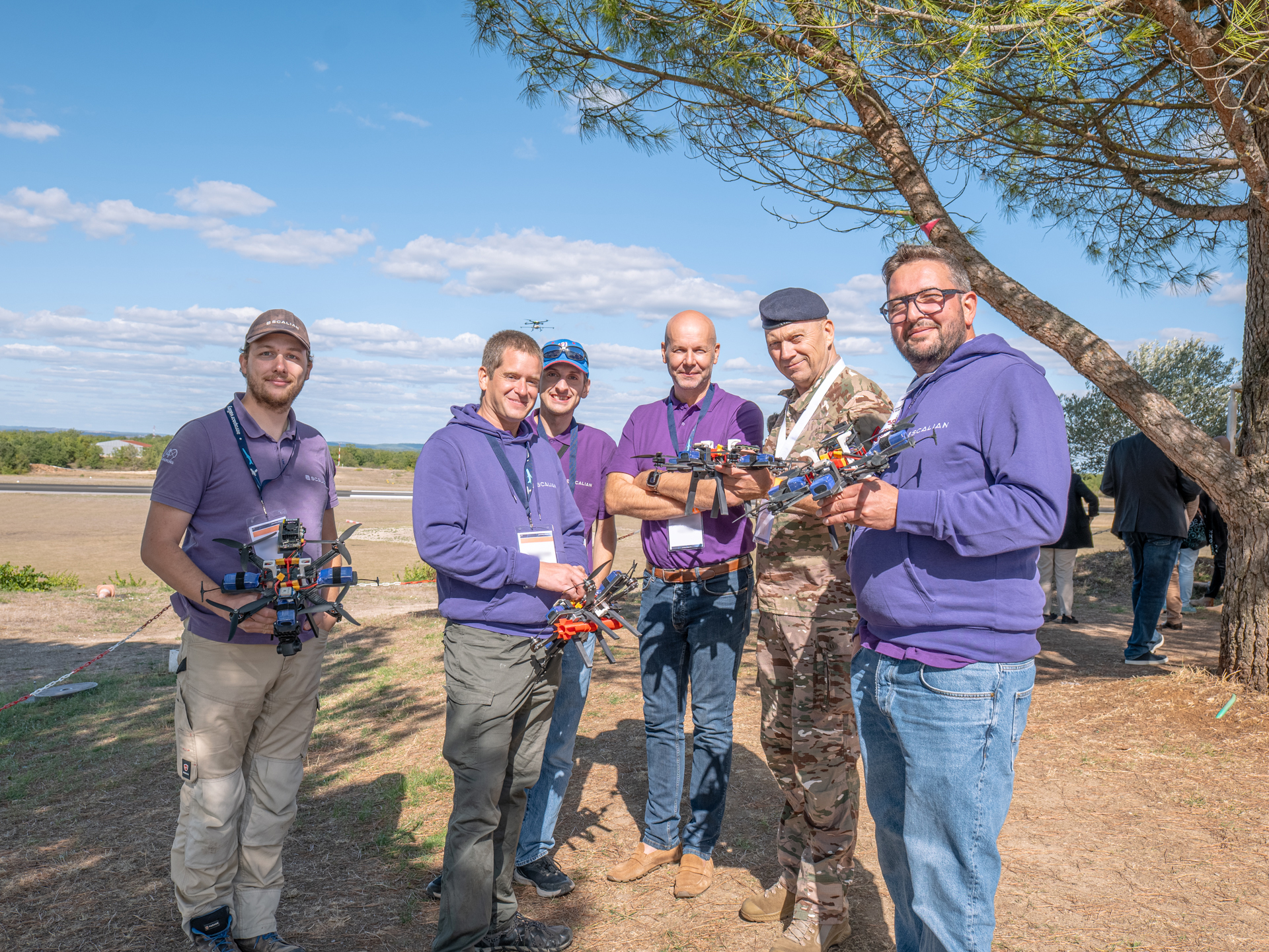
EZ_Chains, embedded intelligence for heterogeneous fleets
Behind that flight is EZ_Chains, our universal embedded platform for swarm coordination, developed in-house by our Unmanned centre of excellence. It rests on four pillars:
Onboard autonomy
Autonomous navigation, automatic take-off and landing, dynamic 3D geofencing and real-time swarm deconfliction. Each agent carries its own decision intelligence rather than depending on a central computer.
Heterogeneous coordination
Up to 36 agents in a single swarm, airborne, ground or surface. A swarm can combine vehicles of different sizes, endurances and payloads to cover an entire mission.
Resilience
Operations continue through communication losses, with reactive obstacle avoidance. The swarm absorbs a degraded environment without breaking the mission.
Interoperability
EZ_Chains is compatible with 80% of autopilots on the market and complies with defence communication and imagery standards (STANAG 4589/4609). It interfaces with existing C2, C4I, UTM and U-space environments.
One technology, adapted sector by sector
EZ_Chains is a core technology that we adapt to our customers’ operational needs:
Defence
Heterogeneous fleet coordination for multi-domain operations: reconnaissance, range extension, automated target recognition, support to tactical manoeuvre. We run this work alongside our partner Thales and several other French defence institutions.
Civil security
With Wildfire Sentinel, developed with Airbus UpNext, EZ_Chains orchestrates a complete wildfire management ecosystem. Surveillance aircraft, water-dropping aircraft, helicopters and autonomous drones operate within a single collaborative system. Fires and smoke are detected and geolocated in real time, reported within seconds in a web application accessible to every actor, from the incident commander to the ground crews. A 4G relay drone restores communications where networks fail, while EZ_Chains manages the segregation of manned and unmanned aircraft to keep the airspace safe.
Industry and energy
Deploying sensor swarms over large areas that are difficult to access, for mapping, surveillance and environmental measurement. Autonomous operations that reduce personnel exposure and the footprint of field interventions.
What the 2026 edition confirmed
Beyond the demonstration, these two days were above all an opportunity for conversations with the ecosystem. Two underlying trends came through.
The first is the speed at which the sector is structuring itself. Professional drone use is no longer experimental: it is entering industrialisation, with the reliability, certification and sovereignty requirements that come with it.
The second is how mature defence and civil security use cases have become. The questions we heard at our stand were no longer about whether swarming works, but about how to integrate it: how to insert it into an existing command chain, how to interface it with vehicles already in service, how to get a concept of operations validated. That is exactly the ground we have been working on for the past decade.